



Generative AI & Lexington Poetry Month
Hey everyone,
I’m excited, although technology keeps changing, causing me to fix some stuff that probably shouldn’t have been broken (which was the topic of my “welcome” post last year.) I’m currently working on a lot of stuff on the backend, including the issue some folks are having with sign-ups, so I want everyone to know that I appreciate your patience. If you’ve sent an email or completed the Contact form, I promise you aren’t forgotten, just “in line,” as it were.
Despite the backlog of tech issues, I wanted to address a particular elephant; even as I update the backend of this site, it’s an elephant whose tendril-like trunk ekes its way into the WordPress changelog as much as it navigates your own personal terms of service with Facebook, TikTok, or even college commencements, and that is this so-called “Artificial Intelligence,” the generative large-language models whose investors require them forced into every aspect of modern life. I want to explicitly define our AI policy, as it concerns the Lexington Poetry Month Writing Challenge.
A few years back, when generative AI was a new and largely untested technology, I created an account during the LexPoMo Writing Challenge called “Bronson’s Poetry AI.” I have occasionally created secondary accounts based on a simple (often silly) premise because I’ve wanted to challenge myself and experiment with the medium. One such account was “MC DK,” an account where I crafted single-line poems out of one- to three-letter words on the high scores of a Donkey Kong machine at Arcadium (R.I.P.) Here is one such masterpiece:
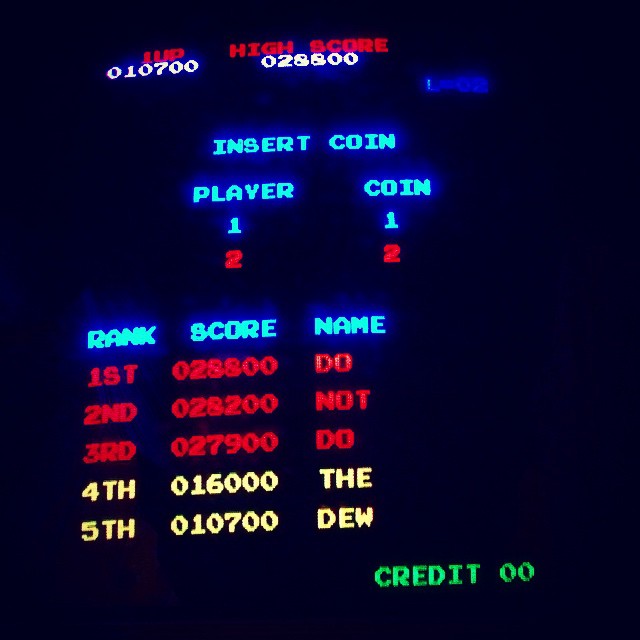
I bring up this example to illustrate that my intentions were mostly silly. My goal with an AI “poet” was to demonstrate the algorithm’s lack of creativity. While it could “technically” create poems, they were trite, impersonal, and forgettable. It could not “create” in the true artistic sense of sharing thoughts with perspective and a yearning for insight. Computers are dumb, even if they sound smart. AI chat bots are, for all intents and purposes, “confidence men,” selling you what you already want with the faux poise of expertise.
While plenty of folks understood my intention, many sent me concerned emails asking if our servers – hosting their creative work – contained AI software. I personally replied to each of those emails guaranteeing that there are no AI models, algorithms, or software on the LexPoMo servers; I explained my process of writing prompts into ChatGPT and Dal-E then copying the results back to this site. I promised that I did not think generative AI served a place in the world of poetry, nor did I ever intend on implementing it on any part of the LexPoMo website.
In all honesty, I chuckled when I first saw those emails because I understood the technology enough to know that it could never “create” art, in the true humanist sense. I wrote an article for my employer at the time demonstrating how the only use was as a middle-man for Google, allowing users to write a search query as a grammatical English question and receive search results in the form of a grammatical English answer. Any attempt at creative work was actually just an attempt at completing the “assignment,” but because the algorithms know which words and syntactic structures tend to impress, it’s easy to mistake “plagiarism” for “art.” I assumed everyone else shared my view and saw these products for what they were. That is, unfortunately, not the case.
In the years since “Bronson’s Poetry AI” published nonsense about “twilight whispers” and “roses’ sweet perfume,” we’ve seen an explosion in AI products as every businessman is forcing it into things it doesn’t belong. We’ve seen tech CEOs make life-altering decisions based on prompts; therapists went on strike to prevent being replaced by chatbots; and we’ve even coined the term “AI Psychosis” to describe an increasingly common condition where the agreeability of chatbots can lead susceptible users to amplify delusional thinking (potentially affecting venture capitalists or even helping cause a preventable death.)
And that doesn’t even mention the environmental catastrophe of data centers, which pollute the air and siphon communities’ water supplies, fast-tracking nuclear power plants (even here in Kentucky) to keep up with the massive energy drain required for this snake oil. People are losing their jobs not because AI can replace them but because grifters have convinced thousands of powerful people that it could.
I recently wrote a blog article with my updated 2026 feelings on AI and, to sum it up, I’m not a fan. Even when I’ve been forced to use it, I ended up disabling it. I don’t think it’s helpful, and even if it were, the advantages are far outweighed by its devastating effects on the environment, our communities, and the economy.
With that in mind, I want Lexington Poetry Month to be AI-free. For the Writing Challenge on this website, we have no intention of ever using it for any part of the site. And as far as using it to write, I trust the folks who grace us with their perspectives, so I don’t think I’d need to say this, but just to keep things clear, do not write poetry with generative AI.
If you want to do the thing I did, to prove it’s bad, please don’t; we know it’s bad. If you want to “consult it” because you worry you aren’t talented, just go back and read some of my poems to see that it doesn’t matter. I don’t consider myself a poet, but it wouldn’t matter if I did because art is completely subjective. I do consider myself a writer, though. I respect artists and craftsfolk from all walks of life. And while I can only speak for myself, I’d much rather see your attempt at “bad” poetry than anything coughed out of Grok’s exhaust valve.
With that out of the way, I’m excited for this year’s Lexington Poetry Month and hope you are, too! Please join us this year in an awesome month of poetry, and feel safe knowing that, while the robots aren’t welcome, everyone else is.
Love and Light,
Bronson O’Quinn
2 thoughts on "Generative AI & Lexington Poetry Month"
Leave a Reply
You must be logged in to post a comment.
<3
thanks for the write up (and all the links!), Bronson!