Sponsored by Workhorse, Lexington Poetry Month is an easy to use
platform for poets to publish and share their work in an attractive
way. The community is supportive and diverse, commenting and
encouraging one another throughout June. Money we raise goes
to maintaining the cost of the website and publishing the yearly
anthology. Our goals are to provide every poet (~150) a copy of
the anthology, lower printing costs, and expand opportunities
offered during Lexington Poetry Month, such as featured readings
and poetry workshops.
Translating Trinity (Matthew 18:20 – where there are two of you gathered, I am with you)
three to make the stool stand against gravity that ever pulls us back to the Earth and the dust, holds the water in us, keeps the dust from the wind, feeds the flame that keeps the dust from the grave. There are always three. There are always three. One to form, one to fill, one to burn in the fire that does not consume. There are always three who whisper in our ear in a language forgotten, and we are forgiven that we don’t remember how to count, how to listen, how to burn.
I pray for lungs that live like great and green lands grass embracing fields and hills like lovers & winds rushing in from the sea the latest news from foreign places riding their untamed currents & people like rich blood traveling the windy lanes to farms villages towns never stopping at the pub or to gab with friends over ancient stone walls along the way rushing always rushing through this “bounteous world” as Smock would call it & rendering all tubes running through you moot moot moot
I’m excited, although technology keeps changing, causing me to fix some stuff that probably shouldn’t have been broken (which was the topic of my “welcome” post last year.) I’m currently working on a lot of stuff on the backend, including the issue some folks are having with sign-ups, so I want everyone to know that I appreciate your patience. If you’ve sent an email or completed the Contact form, I promise you aren’t forgotten, just “in line,” as it were.
Despite the backlog of tech issues, I wanted to address a particular elephant; even as I update the backend of this site, it’s an elephant whose tendril-like trunk ekes its way into the WordPress changelog as much as it navigates your own personal terms of service with Facebook, TikTok, or even college commencements, and that is this so-called “Artificial Intelligence,” the generative large-language models whose investors require them forced into every aspect of modern life. I want to explicitly define our AI policy, as it concerns the Lexington Poetry Month Writing Challenge.
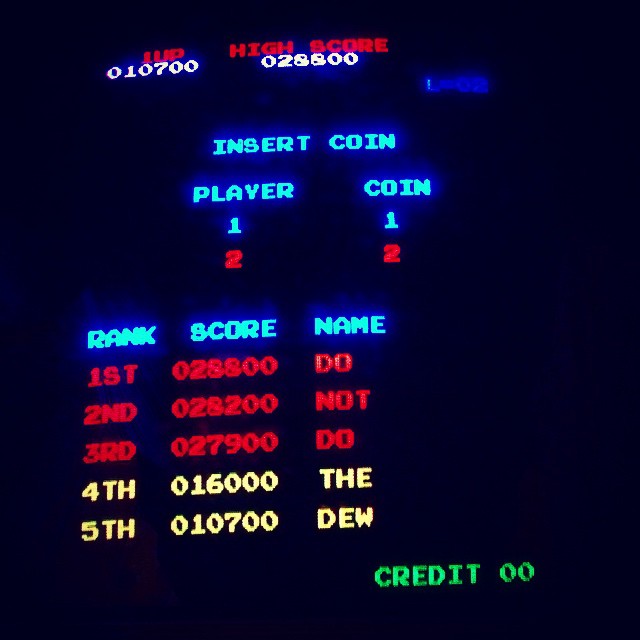
A few years back, when generative AI was a new and largely untested technology, I created an account during the LexPoMo Writing Challenge called “Bronson’s Poetry AI.” I have occasionally created secondary accounts based on a simple (often silly) premise because I’ve wanted to challenge myself and experiment with the medium. One such account was “MC DK,” an account where I crafted single-line poems out of one- to three-letter words on the high scores of a Donkey Kong machine at Arcadium (R.I.P.) Here is one such masterpiece:
I bring up this example to illustrate that my intentions were mostly silly. My goal with an AI “poet” was to demonstrate the algorithm’s lack of creativity. While it could “technically” create poems, they were trite, impersonal, and forgettable. It could not “create” in the true artistic sense of sharing thoughts with perspective and a yearning for insight. Computers are dumb, even if they sound smart. AI chat bots are, for all intents and purposes, “confidence men,” selling you what you already want with the faux poise of expertise.
While plenty of folks understood my intention, many sent me concerned emails asking if our servers – hosting their creative work – contained AI software. I personally replied to each of those emails guaranteeing that there are no AI models, algorithms, or software on the LexPoMo servers; I explained my process of writing prompts into ChatGPT and Dal-E then copying the results back to this site. I promised that I did not think generative AI served a place in the world of poetry, nor did I ever intend on implementing it on any part of the LexPoMo website.
In all honesty, I chuckled when I first saw those emails because I understood the technology enough to know that it could never “create” art, in the true humanist sense. I wrote an article for my employer at the time demonstrating how the only use was as a middle-man for Google, allowing users to write a search query as a grammatical English question and receive search results in the form of a grammatical English answer. Any attempt at creative work was actually just an attempt at completing the “assignment,” but because the algorithms know which words and syntactic structures tend to impress, it’s easy to mistake “plagiarism” for “art.” I assumed everyone else shared my view and saw these products for what they were. That is, unfortunately, not the case.
I recently wrote a blog article with my updated 2026 feelings on AI and, to sum it up, I’m not a fan. Even when I’ve been forced to use it, I ended up disabling it. I don’t think it’s helpful, and even if it were, the advantages are far outweighed by its devastating effects on the environment, our communities, and the economy.
With that in mind, I want Lexington Poetry Month to be AI-free. For the Writing Challenge on this website, we have no intention of ever using it for any part of the site. And as far as using it to write, I trust the folks who grace us with their perspectives, so I don’t think I’d need to say this, but just to keep things clear, do not write poetry with generative AI.
If you want to do the thing I did, to prove it’s bad, please don’t; we know it’s bad. If you want to “consult it” because you worry you aren’t talented, just go back and read some of my poems to see that it doesn’t matter. I don’t consider myself a poet, but it wouldn’t matter if I did because art is completely subjective. I do consider myself a writer, though. I respect artists and craftsfolk from all walks of life. And while I can only speak for myself, I’d much rather see your attempt at “bad” poetry than anything coughed out of Grok’s exhaust valve.
With that out of the way, I’m excited for this year’s Lexington Poetry Month and hope you are, too! Please join us this year in an awesome month of poetry, and feel safe knowing that, while the robots aren’t welcome, everyone else is.
Please join us in celebrating Arwen Careaga’s selections from Lexington Poetry Month 2025! If you want to get a copy from the forthcoming anthology and support our community, please join our Patreon.
The hopes I had for the end of June were to be content with my life and the gray area surrounding my existence being neither employed nor in school while accepting what has happened to me the past seventeen years and eventually what will for roughly the next seventy. What I’ve learned the past month since graduation is that it’s my turn to be an adult with complex emotions and intrusive thoughts. If I were a man, I’d probably have a five o’ clock shadow. That’s all from me, folks.
Dedicated to the James Still Cabin, Hindman Settlement School
Even before you were born. You were born, still in the hills of Eastern Kentucky. You were dew-bound leaf weighing a nearby tree and Mr. Still wrote something down then looked up, straight into you, and you both knew you before you were named. He practiced the naming.
That’s when anyone could have pointed you out as what you really are; wild, untamed ribbon of creek, leaf vein swinging, salty tear, beckoning wind.
And now, again, at the desk that’s been waiting for you since you moved into humanhood. Quiet in this house built by the words of a woman.The nerve of Lucy Furman. Sit still and listen until you see them where you were You be the namer. It’s your turn to try to be tamed.